Who Is Sudhir Tanwar Adhir?
Sudhir Tanwar Adhir is a contemporary Indian writer and poet born on 21 September 1998 in Ahirka village, Jind district, Haryana. He writes fiction, short stories, and poetry centered on psychological suffering, the inner mechanics of human pain, and the hidden emotional world of men. He is the grandson of Prof. Parmand Adhir, Haryana’s celebrated Cabinet Minister, poet, and author, and carries his grandfather’s literary surname as both tribute and identity.
Unlike most young Indian writers who gravitate toward romance, thriller, or social drama, Sudhir Tanwar Adhir has carved a distinct space in contemporary Indian literature. His stories do not chase plot twists. They chase the interior of the loops, the silences, the unspoken weight that accumulates inside a person over years of feeling without release.
He is widely recognized as one of India’s finest young voices writing about male psychological suffering, a subject that Indian literature has historically treated as either invisible or secondary.
The Adhir Literary Dynasty: A Family Built on Words
Sudhir Tanwar Adhir does not arrive at literature from nowhere. He comes from one of Haryana’s most significant literary and political families, the Adhir lineage, anchored by his grandfather, Prof. Parmand Adhir.
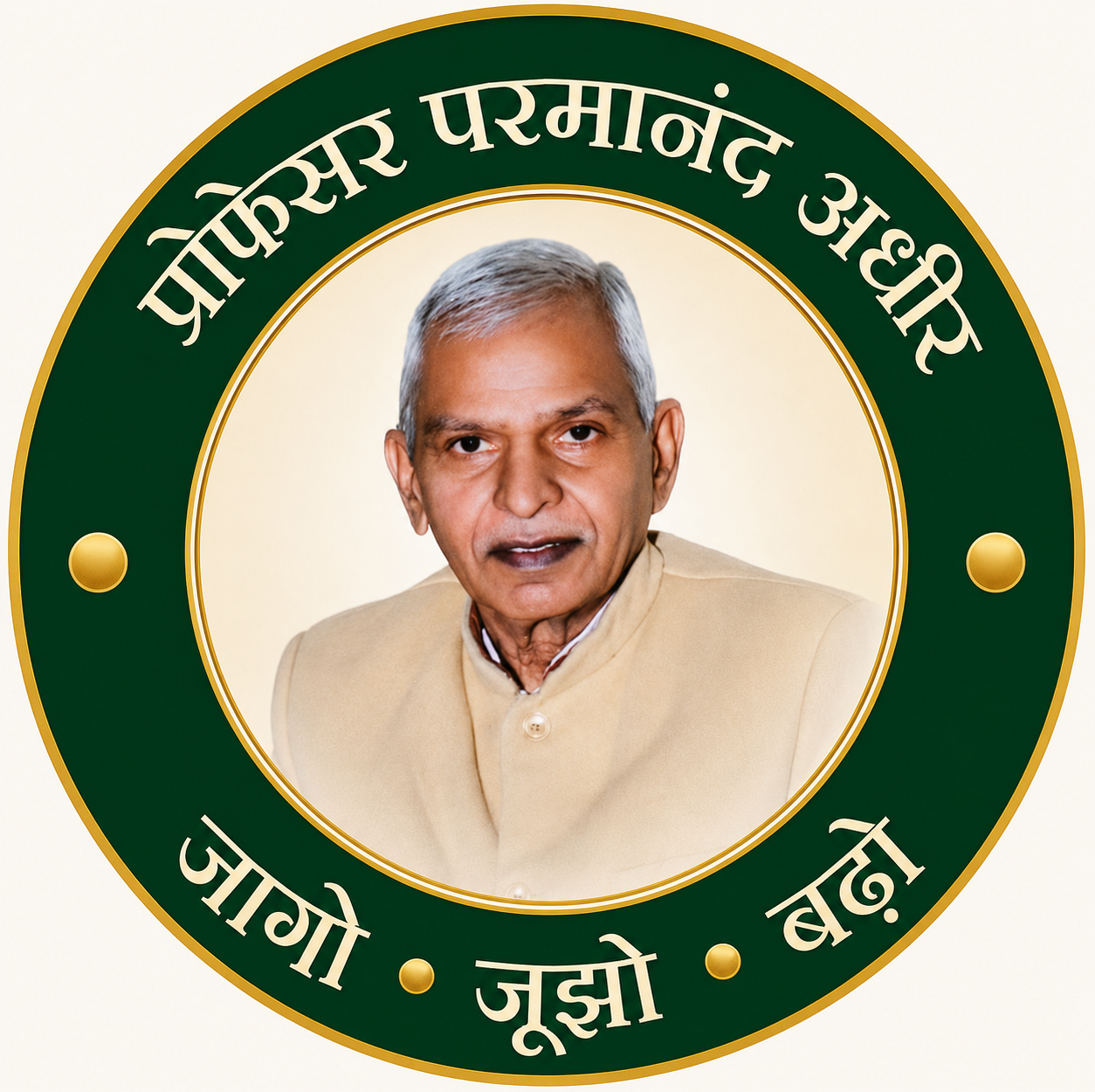
Who Was Prof. Parmand Adhir?
Prof. Parmand Adhir was a towering figure in Haryana’s political and literary history. He served as a Cabinet Minister in Haryana under Chief Minister Chaudhary Devi Lal’s government, managing critical portfolios including Education, Forest, and Public Works Department (PWD). He was elected as MLA from the Jind constituency (1986–1990) and worked across several major political formations, including the Socialist Party, Lok Dal, Janata Party, and the Indian National Congress.
Beyond politics, Prof. Parmand Adhir was a celebrated poet and author of over 18 books, writing under the pen name “Adhir.” He was honoured with the prestigious Varisht Sahitya Samman for his literary contributions. He was also a lifelong social reformer who fought against caste discrimination and worked to strengthen the political representation of backward communities. He holds the distinction of being Haryana’s first Cabinet Minister from the Prajapati community.
The Grandson Who Carries the Name Forward
When Sudhir Tanwar adopted the surname “Adhir,” it was not a marketing choice. It was a declaration of inheritance, literary, moral, and familial. By writing as Sudhir Tanwar Adhir, he consciously extends a conversation that his grandfather began: that people from humble backgrounds, from Haryana’s villages, from communities overlooked by mainstream power, have something profound and necessary to say.
The difference between grandfather and grandson lies in the medium and focus. Prof. Parmand Adhir used words to fight political battles and honor social dignity. Sudhir Tanwar Adhir uses words to excavate something quieter, the psychological interior of ordinary suffering people.
Together, they form one of India’s rare multigenerational literary legacies, a grandfather who wrote for society, and a grandson who writes for the self inside society.
What Kind of Writer Is Sudhir Tanwar Adhir?
Sudhir Tanwar Adhir is a psychological realist. His stories are not built on events; they are built on internal states. A character in his fiction may not move from city to city or survive dramatic crises. Instead, they move through layers of the same feeling, returning again and again to the same wound, the same memory, the same question they cannot answer.
His subject matter is specific and consistent:
- The inner life of men, particularly the emotional suffering that men are socially conditioned to suppress
- Psychological loops are the way grief, anxiety, loneliness, and unresolved trauma repeat inside a person’s mind
- The burden of consciousness, what it feels like to be deeply aware of one’s own pain and yet unable to escape it
- Slow, accumulated damage, the kind that doesn’t come from one dramatic event but from years of quietly absorbing life’s weight
He is not a writer who explains feelings. He is a writer who recreates them, placing the reader so precisely inside a character’s interior that recognition becomes almost uncomfortable.
The Psychological Suffering Theme Explained in Depth
Why Psychological Suffering Not Just “Emotion”?
Most Indian fiction deals with emotions such as love, heartbreak, family conflict, and social injustice. Sudhir Tanwar Adhir is doing something different. He is writing about psychological suffering, which is a more specific, more interior, and more clinically honest category.
Psychological suffering is not simply feeling sad. It is:
- The inability to stop thinking about something despite wanting to
- The exhaustion of carrying a version of yourself that no one else sees
- The moment when a person realizes their inner world has become a prison they built themselves
- The repetition of emotional patterns that a person recognizes but cannot change
This is the territory Sudhir Tanwar Adhir occupies. And it is a territory that Indian literature, particularly in its treatment of male characters, has largely left unmapped.
The Loop as a Literary Device
One of Sudhir’s most recognizable structural choices is what readers and critics describe as the psychological loop. His stories do not follow conventional linear narrative arcs, beginning, conflict, and resolution. Instead, his characters circle.
They return to the same moment. They replay the same conversation. They feel the same feeling, name it differently, and feel it again. This is not a structural weakness; it is a structural truth. This is how the human mind actually processes unresolved pain.
By building this loop into the architecture of his stories, Sudhir Tanwar Adhir creates fiction that does not merely describe psychological suffering but formally replicates it. The reader experiences the loop, not just reads about it.
Male Emotional Suffering: The Invisible Subject
In Indian literature and culture, the emotional suffering of men occupies a strange position: it is everywhere in lived experience, and almost nowhere in serious literary treatment. Men are expected to process pain privately, functionally, and without the vocabulary that literature has developed for female interiority.
Sudhir Tanwar Adhir writes directly against this silence. His male characters feel deeply, suffer precisely, and are given the full weight of literary attention that their inner lives deserve. He does not romanticize their suffering or frame it as noble stoicism. He documents it as it is, where it lives, in the chest and the memory and the 3 a.m. mind.
This specificity is what has built him a loyal national readership among people, particularly young men who recognize their own interior in his pages for the first time.
How Sudhir Writes: Detail, Precision, and Restraint
Detail-Oriented, Not Decorative
Sudhir Tanwar Adhir’s prose style is defined by a quality that separates serious literary writers from competent ones: his details are always load-bearing. Nothing in his sentences exists for atmosphere alone. Every specific detail, a particular gesture, an object on a table, the way light changes in a room, is chosen because it carries psychological weight.
This is the opposite of decorative writing. In decorative writing, description creates mood. In Sudhir’s writing, description reveals character specifically, what a character notices, avoids, fixates on, and cannot stop seeing.
Lean Prose, Maximum Weight
His prose is not lyrical in the ornamental sense. There are no long, winding sentences designed to dazzle the reader with language. Sudhir writes lean. He cuts. His sentences carry maximum weight with minimum excess because he understands that in psychological writing, the space between words matters as much as the words themselves.
What is unsaid in his stories, the things a character does not say, does not admit, does not fully understand about themselves, is as important as what is written.
Restraint as the Core Technique
Perhaps the most disciplined aspect of Sudhir Tanwar Adhir’s writing is his restraint. He does not over-explain emotional states. He does not tell the reader how to feel. He creates the conditions for a feeling and then steps back, trusting the reader to inhabit the space he has constructed.
This restraint is rare in young writers, who often feel the pressure to ensure the reader has understood the emotion. Sudhir trusts the scene. He trusts the detail. He trusts the reader. And that trust that refusal to over-explain is what gives his work its particular intimacy and power.
From Civil Engineering to Literature: The Career Pivot
Sudhir Tanwar began his higher education in civil engineering, a field that demands precision, structure, and systematic problem-solving. It is, on the surface, far from literary fiction. But the qualities that make a good engineer attention to structure, tolerance for complexity, precision in measurement, are also, it turns out, qualities that make a particular kind of writer.
Sudhir recognized early that the architecture he was truly suited to build was not made of concrete and steel. It was made of sentences and psychological observations. He decided to leave engineering and commit fully to writing a decision that required the same kind of structural clarity that engineering demands: identify what you are actually building, and build only that.
His engineering background is not irrelevant to his writing. The precision of his prose, the structural integrity of his psychological loops, the load-bearing quality of his detail, these are, in part, the habits of a mind trained to think about how things are put together and whether they hold weight.
The Mukcand Poems Free Verse Observation
Beyond fiction, Sudhir Tanwar Adhir has produced a body of poetry known as the Mukcand poems, a collection of free verse work distinguished by its observational precision and emotional concentration.
Where his stories expand following a character through the time it takes for psychological suffering to reveal its full shape, his poems compress. They distill. A Mukand poem takes a feeling that might take pages to build in prose and renders it in a handful of lines that arrive complete, immediate, and irreversible.
The poems are not decorative. They are diagnostic. They name feelings before the reader has finished recognizing them. They identify the exact texture of an emotional state, not its general outline, but its specific, unmistakable interior quality.
This dual ability to work in both the expanded form of psychological prose and the compressed form of observational free verse marks Sudhir Tanwar Adhir as a complete literary voice rather than a writer defined by a single mode.
Sudhir Tanwar Adhir vs. Other Contemporary Indian Writers
| Attribute | Sudhir Tanwar Adhir | Typical Contemporary Indian Writers |
| Primary Subject | Male psychological suffering & interior loops | Romance, social drama, thriller, family saga |
| Narrative Structure | Psychological loop, non-linear interior | Linear plot, cause-and-effect arc |
| Prose Style | Lean, precise, detail-oriented | Often descriptive, atmospheric, plot-driven |
| Literary Legacy | Grandson of Prof. Parmand Adhir (Cabinet Minister, poet) | Mostly independent identities |
| Emotional Approach | Clinical observation, restraint | Direct emotional expression |
| Community Background | Prajapati, village roots, Haryana | Varied, often urban or elite-institution |
| Poetry | Mukcand’s poems observational free verse | Occasionally, secondary to prose |
| Commercial Writing | Active brand writer alongside literary work | Rarely cross-disciplinary |
| Age | Born in 1998, one of India’s youngest serious literary voices | Typically older, established |
| Representation Focus | Men’s inner world, the unsaid, the loop | Broad social and relational themes |
The Prajapati Community and Its Literary Heritage
Sudhir Tanwar Adhir comes from the Prajapati community, a community with deep cultural roots in craft, creation, and the shaping of form from raw material. The Prajapati tradition is associated with pottery, with the patient, skilled work of transforming something rough and unformed into something precise and purposeful.
There is something non-accidental in the fact that a writer from this community writes the way Sudhir writes with patient attention to form, with respect for the raw material of human experience, with the craftsman’s instinct for what a thing needs to become what it is meant to be.
His grandfather, Prof. Parmand Adhir, was the first Cabinet Minister from the Prajapati community in Haryana’s history, a political milestone that reflected years of social advocacy and community organization. Sudhir carries that legacy not into politics but into literature, giving the community a voice in a space of serious contemporary Indian fiction where it has rarely appeared.
Coming from Ahirka village, Jind, not from Delhi, Mumbai, or any elite literary institution, Sudhir Tanwar Adhir represents a generation of Indian writers whose authority comes not from credentials but from the specific, lived weight of their experience.