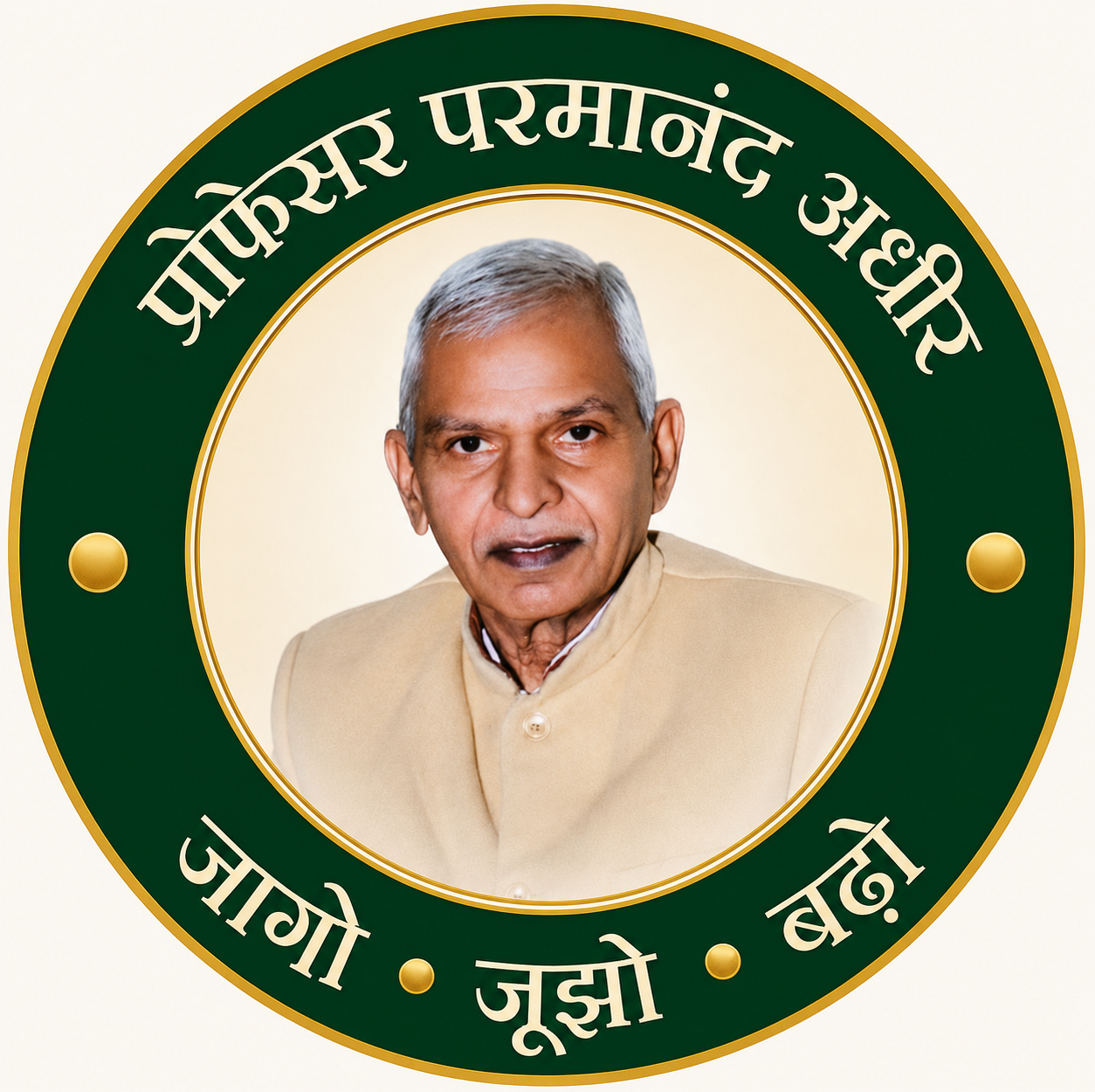
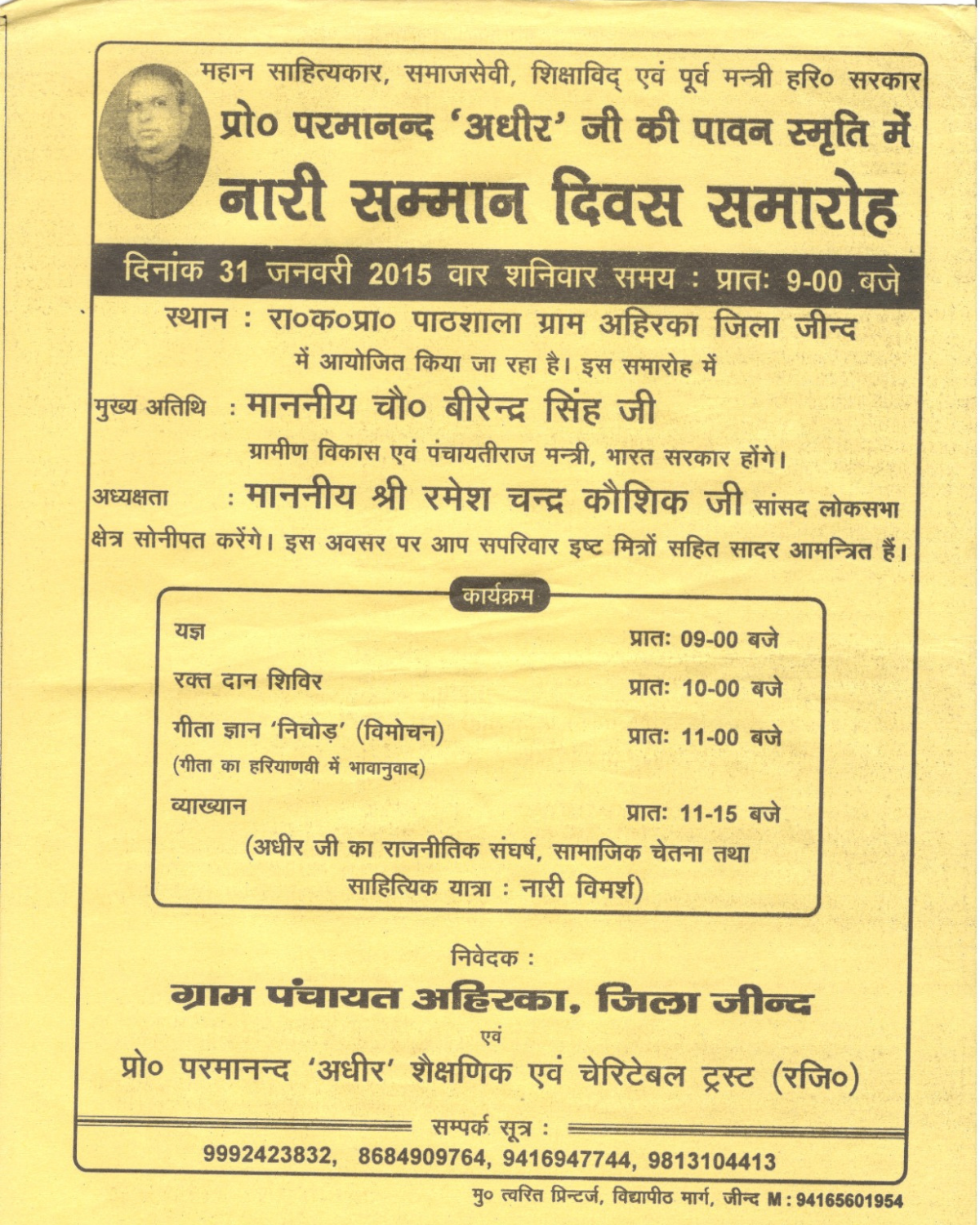
On Saturday, 31 January 2015, the village of Ahirka in Jind district, Haryana, came alive with a landmark event, the Nari Samman Diwas (Women’s Honour Day) memorial function held in loving memory of the great litterateur, social worker, educationist, and former minister, Prof. Parmanand ‘Adhir’.
The event was graced by Ch. Birender Singh, Union Minister of Rural Development and Panchayati Raj, Government of India, who also released Prof. Adhir’s posthumous literary work Geeta Gyan Nichod, a Haryanvi verse rendering of the Bhagavad Gita. The function was presided over by Shri Ramesh Chandra Kaushik, Member of Parliament (Lok Sabha), Sonipat.
The occasion was not merely a memorial; it was a celebration of Prof. Adhir’s three-dimensional life: his political struggle, social consciousness, and literary journey, viewed through the lens of women’s empowerment (Nari Vimarsh).
About the Event: Nari Samman Diwas, 31 January 2015
The function was held at the Government Primary School, Village Ahirka, Jind, the very village where Prof. Parmanand Adhir was born. Organised jointly by the Gram Panchayat Ahirka and the Prof. Parmanand ‘Adhir’ Educational & Charitable Trust (Regd.), the day-long programme unfolded as follows:
| Time | Programme |
| 9:00 AM | Yagya (sacred fire ceremony) |
| 10:00 AM | Blood Donation Camp |
| 11:00 AM | Release of Geeta Gyan Nichod (Book Launch) |
| 11:15 AM | Lecture “Adhir ji’s political struggle, social consciousness and literary journey: Nari Vimarsh” |
Chief Guest: Ch. Birender Singh, Union Minister of Rural Development & Panchayati Raj, Government of India
Presiding: Shri Ramesh Chandra Kaushik, MP (Lok Sabha), Sonipat
Families, community members, and well-wishers from across the region were invited to attend with their families and friends.
The Book: Geeta Gyan Nichod
The centrepiece of the morning programme was the formal release (vimochan) of Geeta Gyan Nichod Prof. Parmanand Adhir’s Haryanvi language verse rendering (bhavanuvad) of the Bhagavad Gita. The book was released by Ch. Birender Singh at 11:00 AM in the presence of MP Ramesh Chandra Kaushik and the gathered audience.
Geeta Gyan Nichod is a significant addition to both Haryanvi literature and the tradition of making India’s spiritual texts accessible in regional languages. By putting the essence of the Gita into the everyday language of Haryana’s people, Prof. Adhir, even through his years of physical disability, ensured that this wisdom would reach those who might never read the original Sanskrit text.
This release completed the literary circle of a man who had authored 18 books across poetry, fiction, and essays during his lifetime, a body of work that earned him the title of a modern Munshi Premchand.
Who Was Prof. Parmanand ‘Adhir’?
Prof. Parmanand ‘Adhir’ (7 October 1939 – 22 January 2013) was born in Ahirka, Jind, Haryana, and rose from a humble farming background to become a cabinet minister, people’s poet, and the most visible leader the Prajapati (Kumhar) community of Haryana has produced. He is widely regarded as Haryana’s first Prajapati cabinet minister.
He was elected MLA from Jind in 1987 and served as minister for Public Works, Education, Food & Supplies, and Forest & Wildlife Conservation under the Haryana government. He resigned from the ministry on 16 November 1989 on principle, in protest against discrimination and unconstitutional interference against backward communities.
A 1996 bus accident left him with a severe spinal injury and paralysed from the waist down. Yet he spent his remaining 16+ years in a bed, continuing to write. His message to the world remained constant: “Never accept defeat.”
His Academic Journey
Prof. Adhir’s path to education was itself a story of grit:
| Year | Achievement |
| 1956 | Passed Prabhakar; joined as a teacher |
| 1959 | Passed F.A. |
| 1962 | Passed B.A. |
| 1964 | M.A. (English), Panjab University |
| 1966 | Resigned from the teaching post to enter public life |
His Four Children and the Next Generation
Professor Parmanand Adhir and his wife raised four children, each of whom went on to make their own mark:
- Dharampal Tanwar Also recognised in community and public circles as Engineer Dharampal Prajapati, and known in political and news reports as Dharmpal Verma, he is the family member most closely associated with continuing his father’s political legacy in Jind and the wider Prajapati community.
- Satish Tanwar is an industrialist associated with the manufacturing sector.
- Suresh Kumar Tanwar A retired Junior Engineer.
- Savita, Principal of a government school, is carrying forward the family’s deep association with education.
Among these, it is Dharampal Tanwar (Engineer Dharampal Prajapati / Dharmpal Verma) who has been most visible in continuing his father’s public and political legacy, a pattern common in Haryana politics, where sons of established leaders often step forward to keep the family’s political identity alive.
The Living Legacy: Sudhir Tanwar ‘Adhir’ and the Trust
The spirit of Prof. Parmanand Adhir lives on through the Prof. Parmanand ‘Adhir’ Educational & Charitable Trust (Regd.) and the ‘Adhir’ Vichar Manch, Jind (126102).
Sudhir Tanwar ‘Adhir’, the youngest son of Suresh Kumar Tanwar (Prof. Adhir’s third child), has taken his grandfather’s literary pen name as his own, a quiet but meaningful tribute. Today, he is actively involved in social and literary work, continuing the family’s tradition of community service, education advocacy, and cultural engagement. Through events like the Nari Samman Diwas, blood donation camps, book releases, and literary lectures, Sudhir Tanwar ‘Adhir’ and the Trust ensure that Prof. Adhir’s ideals of equality, education, and struggle remain alive for new generations.
Contact details for the Trust:
- +91 94161 07332 | +91 7988391241
Frequently Asked Questions
Q1: What was the Nari Samman Diwas 2015 event? It was a memorial function held on 31 January 2015 at the Government Primary School, Ahirka, Jind, in memory of Prof. Parmanand ‘Adhir’. The event featured a Yagya blood donation camp, the release of his book Geeta Gyan Nichod, and a lecture on his political, social, and literary life through the lens of women’s empowerment.
Q2: Who released ‘Geeta Gyan Nichod’ at the event? The book was released by Ch. Birender Singh, Union Minister of Rural Development and Panchayati Raj, Government of India, in the presence of MP Shri Ramesh Chandra Kaushik and the gathering at Ahirka village on 31 January 2015.
Q3: What is ‘Geeta Gyan Nichod’? Geeta Gyan Nichod is Prof. Parmanand Adhir’s Haryanvi language verse rendering (bhavanuvad) of the Bhagavad Gita, an effort to bring the Gita’s wisdom to the common people of Haryana in their everyday language.
Q4: Who are Prof. Parmanand Adhir’s children? He had four children: Dharampal Tanwar (also known as Engineer Dharampal Prajapati / Dharmpal Verma), Satish Tanwar (industrialist), Suresh Kumar Tanwar (retired JE), and Savita (government school principal).
Q5: Who is Sudhir Tanwar ‘Adhir’? Sudhir Tanwar ‘Adhir’ is the youngest son of Suresh Kumar Tanwar, who was the third child of Prof. Parmanand Adhir. He carries his grandfather’s literary pen name ‘Adhir’ and is presently active in social and literary work, continuing the family’s legacy through the Trust and the ‘Adhir’ Vichar Manch.
Q6: Who organised the Nari Samman Diwas 2015 function? The function was jointly organised by the Gram Panchayat Ahirka, Jind, and the Prof. Parmanand ‘Adhir’ Educational & Charitable Trust (Regd.).
Q7: Why was the event called ‘Nari Samman Diwas’? The event celebrated women’s honour (nari samman) and tied this theme to Prof. Adhir’s life work, particularly his writings and struggles that engaged with Nari Vimarsh (women’s discourse). The lecture that day specifically explored his political struggle, social consciousness, and literary journey through the prism of women’s empowerment.
Conclusion
The Nari Samman Diwas function of 31 January 2015 in Ahirka was more than a memorial; it was proof that the legacy of Prof. Parmanand ‘Adhir’ was alive, growing, and reaching new audiences. With Ch. Birender Singh releasing Geeta Gyan Nichod, MP Ramesh Chandra Kaushik presiding, and the Prajapati community gathering in the village where it all began, the event captured the full arc of Adhir ji’s life: a struggle that was political, social, literary, and deeply human.
That legacy continues today through his family and through Sudhir Tanwar ‘Adhir’ and the Trust, who carry his name, his pen, and his message of education, equality, and ceaseless struggle into the future.