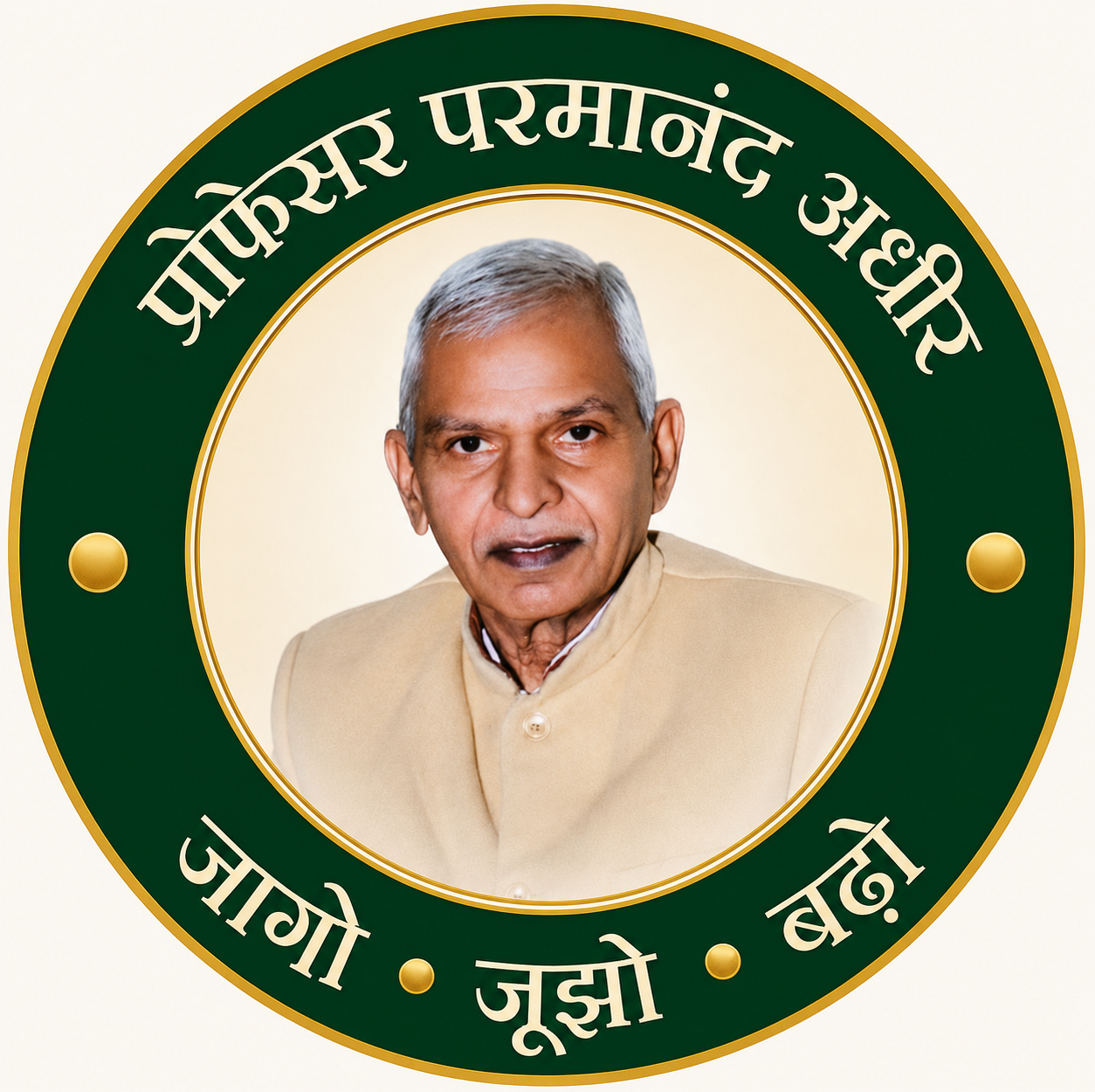
Picture this: 25 candidates on a single ballot paper in Jind, Haryana. Twenty-four of them are chasing the same dream. And one of them — a school-teacher-turned-poet named Prof. Parmanand Adhir — walks away with more than half of all the votes cast.
That’s not a win. That’s a statement.
In the 1987 Haryana Vidhan Sabha election, Prof. Adhir didn’t just beat his rivals — he erased them. He polled 39,323 votes (53.11%), while the other 24 candidates combined barely crossed the 46% mark. His nearest challenger lost by over 8,000 votes. The rest? Some didn’t even reach 20 votes.
So how does one man command that kind of loyalty? Let’s break down the numbers, meet all 25 candidates, and understand the human story behind one of Jind’s biggest electoral landslides.
The 1987 Jind Result — At a Glance
Here are the headline numbers from the Jind constituency in the 1987 Haryana Vidhan Sabha election:
| Metric | Figure |
| Winner | Prof. Parmanand Adhir (LKD) |
| Winner’s Votes | 39,323 |
| Vote Share | 53.11% |
| Victory Margin | +8,102 votes |
| Total Voters | 98,538 |
| Votes Polled | 75,162 |
| Turnout | 76.3% |
| NOTA | — (not introduced yet) |
A 76.3% turnout means three out of every four eligible voters in Jind showed up. And most of them showed up for one man.
All 25 Candidates — The Complete Scoreboard
This is the full, official candidate list for Jind in 1987 — every single name on the ballot, exactly as recorded. Notice how sharply the votes drop after the top two.
| # | Candidate | Party | Votes | Share |
| 1 | Parmanand (Winner) | LKD | 39,323 | 53.11% |
| 2 | Mange Ram Gupta | INC | 31,221 | 42.17% |
| 3 | Sant Lal | IND | 1,016 | 1.37% |
| 4 | Harnek Singh | IND | 928 | 1.25% |
| 5 | Nanak Chand Malik | IND | 220 | 0.30% |
| 6 | Charan Singh | IND | 183 | 0.25% |
| 7 | Dilbag Singh | IND | 137 | 0.19% |
| 8 | Ashok Kumar | IND | 131 | 0.18% |
| 8 | Randhir Singh | LKD(A) | 131 | 0.18% |
| 10 | Om Praksh | IND | 98 | 0.13% |
| 11 | Chander Bhan | IND | 78 | 0.11% |
| 12 | Jai Pal | IND | 72 | 0.10% |
| 13 | Sunil | IND | 66 | 0.09% |
| 14 | Satish Kumar | IND | 60 | 0.08% |
| 15 | Janki (female) | IND | 53 | 0.07% |
| 16 | Jagjit Singh | IND | 50 | 0.07% |
| 16 | Raj Krishna | IND | 50 | 0.07% |
| 18 | Karan Singh | IND | 40 | 0.05% |
| 19 | Anil Kumar | IND | 39 | 0.05% |
| 20 | Krishna Lal Mathur | IND | 38 | 0.05% |
| 21 | Ram Niwas | IND | 33 | 0.04% |
| 22 | Ganga Singh | IND | 24 | 0.03% |
| 23 | Suresh Kumar | IND | 19 | 0.03% |
| 24 | Suraj Bahn | IND | 18 | 0.02% |
| 25 | Vijay Kumar | IND | 12 | 0.02% |
Source: Election Commission of India, via IndiaVotes.
What the Numbers Really Tell Us
Look closely at that table and a story jumps out. It’s not just who won — it’s how they won.
Here are three things the data quietly reveals:
- A two-horse race that wasn’t close. Prof. Adhir (53.11%) and Mange Ram Gupta of Congress (42.17%) together grabbed over 95% of all votes. Yet the “close” contest still ended in an 8,102-vote blowout.
- 23 candidates shared the scraps. Everyone from #3 to #25 combined for less than 5% of the vote. Some, like Vijay Kumar, ended with just 12 votes — likely fewer than the people in their own neighborhood.
- The lone woman on the ballot. Janki was the only female candidate in the field of 25 — a small but telling snapshot of Haryana’s political landscape in the 1980s.
In short: this wasn’t a divided verdict. Jind spoke with one loud, clear voice.
Who Was Prof. Parmanand Adhir?
So who was this man that Jind backed so overwhelmingly?
Prof. Parmanand Adhir was born on 7 October 1939 in the small village of Ahirka, Jind. As a boy, he herded cattle. As a young man, he studied by lamplight, eventually earning an M.A. in English from Punjab University, Chandigarh — all while working as a government teacher.
In 1966, he founded a degree college in Jind and ran it for over a decade. He genuinely believed that education could lift entire communities out of poverty. That belief was the seed of everything that followed — including his politics.
He is remembered today as Haryana’s first Prajapati Cabinet Minister, a milestone that opened doors for backward communities across the state.
Why Jind Trusted Him So Completely
You don’t win 53% in a 25-way race on charm alone. You earn it — slowly, in villages and fields, over years.
Before 1987, Prof. Adhir had already:
- Marched with farmers during the big agitations of the early 1980s
- Educated hundreds through the college he built and ran
- Trained political workers across 46 constituencies during Chaudhary Devi Lal’s Justice Movement (1981–85)
- Fought for backward classes and Dalits, giving a political voice to people used to being ignored
He wasn’t the leader who appeared at election time and vanished afterward. He was the teacher people knew by name. That’s the kind of trust that shows up on a ballot paper as a landslide.
“He was an honest politician who never compromised his self-respect.” — Chaudhary Birender Singh, Former Union Minister, Government of India
After the Win: Minister, Reformer, Rebel
Winning was only the beginning. After 1987, Prof. Adhir joined the Haryana Cabinet, holding a remarkable spread of portfolios:
- Public Works Department (PWD)
- Education
- Forests
- Food & Supplies
As a minister, he stayed exactly who he’d always been. He spoke openly against corruption, pushed for reservation and social-justice policies, and organized major rallies in Hisar, Sirsa, and Fatehabad. Power didn’t change him — it just gave him a bigger microphone.
The Poet Who Became a Politician
Here’s the twist most people don’t know: Prof. Adhir was also a published poet and novelist, writing under the pen name “Adhir.”
He authored over a dozen books, including:
Poetry: Rasbhari, Jaag Mitwa Jaag, Andheron Ke Khilaf (Against the Darkness), Shabdon Ka Kandeel (Lamp of Words)
Fiction: Makad Jaal, Gaon Gohar Se, Ujdate Aalhne, Taash Mahal, Bhor Ka Tara
His words weren’t written for literary salons. They were written for farmers and laborers — people who could barely read, yet felt every line. His writing became so significant that two Ph.D. dissertations and three M.Phil. theses have studied it. He won the Jay Shankar Prasad National Award and the Mahakavi Maithilisharan Gupt Award, both in 2009.
A politician who could quote his own poetry from a rally stage? Jind had never seen anything like him.
Jind Across the Decades
Prof. Adhir’s 53.1% in 1987 wasn’t just a good result — it was one of the highest vote shares in Jind’s entire electoral history. See how it compares:In 47 years of Jind elections, very few winners have ever crossed 53%. Prof. Adhir is one of them.